
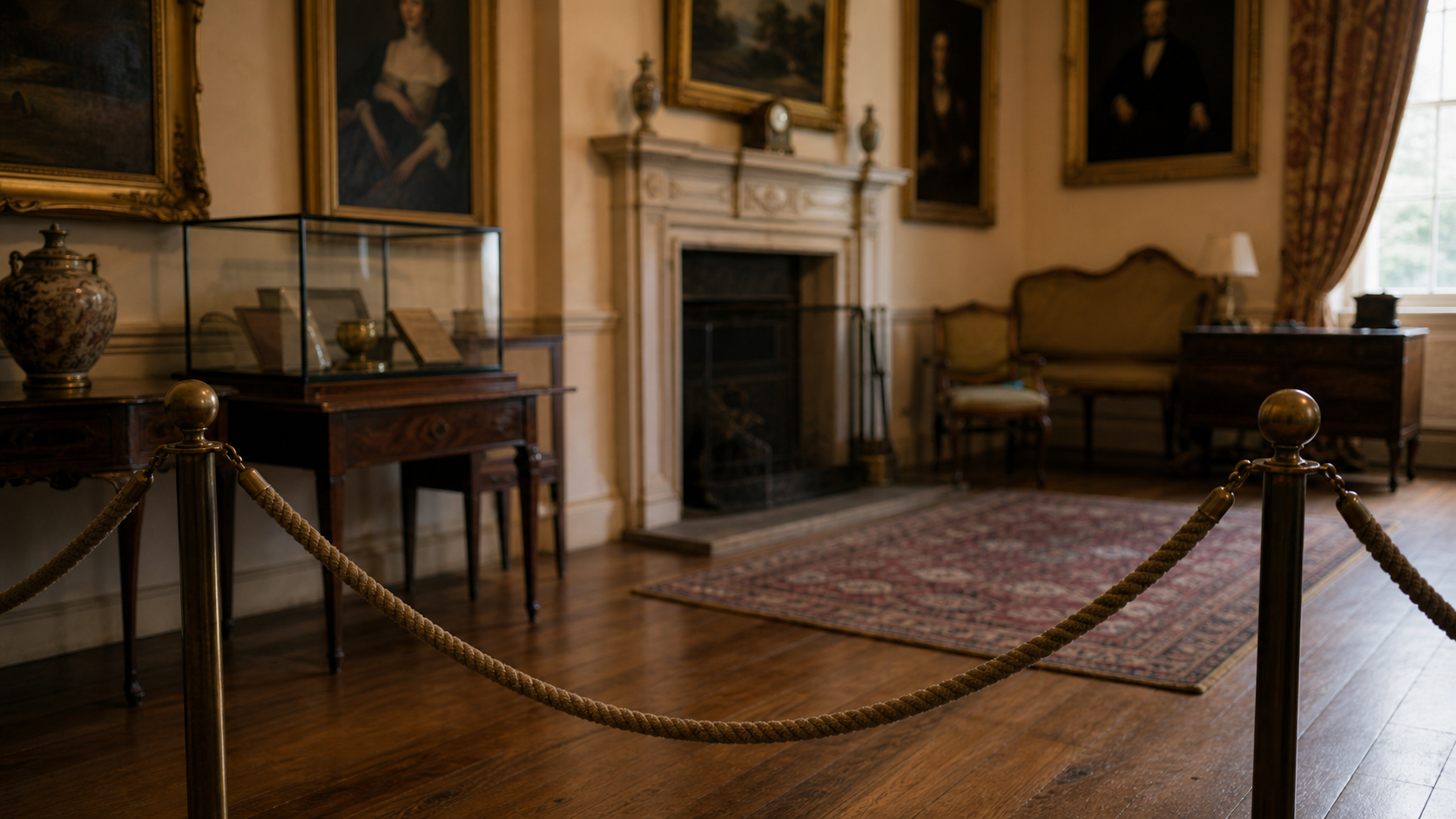
Heritage rarely announces itself as political. It looks too settled for that: the house preserved in careful light, the battlefield path, the guided tour, the gift shop, the plaque, the portrait, the audio guide speaking in a calm voice.
That calm matters. It gives heritage its authority. The visitor is not invited into an argument, but into an atmosphere. The past appears to have arranged itself naturally, as though the surviving buildings, names and stories simply rose to the surface because they deserved to.
But heritage is not the past. It is a selection from the past, maintained in the present, usually with money, land, institutional support and cultural permission behind it.
Preservation is a choice
To preserve one thing is to leave another thing less visible. Britain’s preserved landscape is full of country houses, royal sites, military memory, imperial architecture and aristocratic continuity. It is much less full of the places where rights were argued for, where workers organised, where tenants resisted, where women campaigned, where migrants built communities, or where ordinary people forced institutions to change.
This does not mean every heritage site is propaganda. It means heritage has a politics even when the people running it are sincere, thoughtful and careful. Funding priorities, donor interests, visitor expectations and cultural prestige all shape which histories receive polish and which remain difficult to find.
The result is not usually a lie. It is something subtler: a national memory with unequal lighting.
The comfort of continuity
Heritage is especially powerful because it turns inequality into scenery. A great house can be presented as architecture, taste, family history and national inheritance. Those things may all be present. But so are land ownership, inherited wealth, class power, colonial extraction, domestic labour and political influence.
When the uncomfortable parts are softened, the institution begins to perform a quiet social function. It trains visitors to admire continuity without asking too sharply how that continuity was paid for, protected or reproduced.
This is why heritage can feel apolitical while doing political work. It does not need to tell people what to think. It only needs to make some arrangements feel old, dignified and almost natural.
What gets framed as national
One of the most important words in heritage is “our”. Our history. Our houses. Our monarchy. Our island story. The word sounds generous, but it can hide a great deal.
Who is included in that “our”? Who paid for the things being admired? Who worked in the kitchens, fields, mines, mills and colonies that made the visible inheritance possible? Who was excluded from ownership while being asked to feel pride in the result?
A more honest heritage culture would not need to burn anything down or strip every old building of beauty. It would simply stop pretending that beauty settles the question. A house can be architecturally impressive and politically revealing. A ceremony can be visually magnificent and socially instructive. A preserved object can deserve care while also asking us to remember the labour and power behind it.
The missing public past
Britain has another inheritance that is often harder to see: rights, services, collective institutions, public health, labour protections, housing campaigns, education movements and democratic pressure from below. These are forms of heritage too. They shaped ordinary life far more directly than many celebrated dynasties.
Yet they are less easily turned into a day out. They do not always produce beautiful rooms or giftable objects. They require argument. They make the visitor ask who had power, who challenged it and what was won.
That is precisely why they matter.
Seeing heritage clearly
The point is not to reject heritage. The point is to stop treating it as innocent by default. Heritage can deepen public understanding when it shows the full machinery behind the visible surface. It can also narrow public understanding when it turns power into atmosphere.
The test is simple: does the heritage encounter help people understand how Britain was made, or does it invite them to admire the result while looking away from the process?
The Britain That Never Was by Ian Wilkinson examines heritage as one part of a wider machinery of nostalgia, memory and power.