
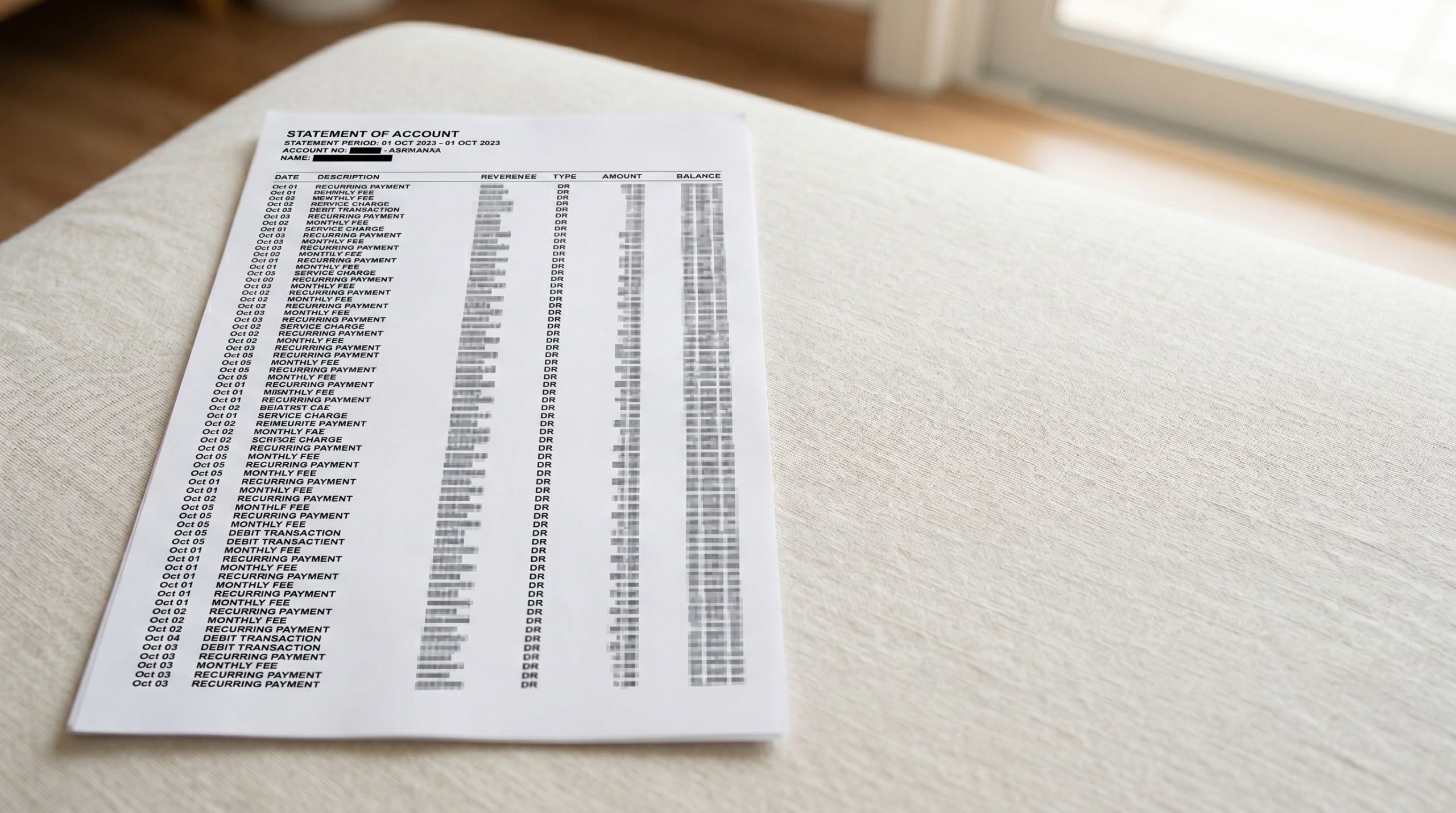
Subscription fatigue is what you feel when money leaves your account in ways you can no longer track clearly.
You may have been prompted by a bank statement that looked larger than expected. Or a notification from an app you had forgotten you had. Or the slow accumulation of a feeling that money was leaving your account in ways you could not quite account for.
If you found the exercise uncomfortable, that was not an accident.
The Architecture of Subscription Fatigue
The subscription model, in its modern form, is built around a specific psychological insight: small, regular payments feel different from large, one-off ones. A £12.99 monthly charge registers very differently to a £155.88 annual payment, even though they are the same amount of money. The subscription industry understands this. It is, in a meaningful sense, the basis of the industry.
This is why subscription services price monthly rather than annually by default. It is why free trials exist: not as a gesture of generosity, but because the moment of becoming a paying customer is designed to feel like nothing at all. You are already using the service. The card details are already saved. The transition from free to paid requires no decision. It simply happens.
It is also why cancellation is almost never as simple as sign-up. The button is harder to find. The process involves more steps. There is frequently an offer, a pause option, a reminder of what you will lose. The friction is asymmetric by design.
The Audit Problem
Most people, when they actually list their subscriptions, find more than they expected.
Research consistently shows — including studies by consumer organisations such as Which? — that consumers underestimate their monthly subscription spend, often by a significant margin. This is not carelessness. It is the predictable result of a system designed to minimise the visibility of its costs. Payments are staggered across different dates. They appear under different company names on bank statements. They renew automatically, which means there is no moment of decision that might prompt a reassessment.
The cumulative cost only becomes visible when you do the work of making it visible. Most people do not do that work regularly. The industry relies on this.
Who Benefits From the Friction
It is worth being clear about who gains from subscription fatigue and who absorbs the cost.
The companies benefit. Every subscriber who continues paying for a service they no longer use is revenue that requires no customer service, no product delivery, and no ongoing persuasion. In the industry, these are sometimes called "sleeper subscribers." The term is revealing. They are not forgotten. They are counted.
The consumer absorbs the cost: financial, cognitive, and in time. The time spent auditing subscriptions, cancelling unwanted services, disputing charges, this is real work, transferred from the provider to the customer, and largely invisible because it happens in small increments.
This transfer of cost and effort from provider to consumer is one of the least-discussed features of the subscription economy. It does not appear in the marketing. It is rarely part of the conversation when a new service launches and is praised for its convenience.
The Convenience Bargain
None of this means subscriptions are without value. Many of them offer genuine convenience, genuine quality, and a genuinely better arrangement than what they replaced.
The point is not that the subscription model is a fraud. The point is that it has been designed carefully, deliberately, and with considerable investment in behavioural research, to extract maximum value from the gap between what you think you are paying and what you are actually paying.
Understanding that design is not the same as rejecting it. But it does change the nature of the relationship. You are not a customer being served. You are a recurring revenue stream being managed.
The question worth asking is whether that is a bargain you consciously agreed to, or one that was simply made for you, gradually, while you were looking at something else.
Read alongside Who Actually Profits From the Subscription Economy?, How We Stopped Owning Things Without Noticing, and Nothing to Show for It for the wider mechanics behind recurring revenue and obscured cost.
Nothing to Show for It by Ian Wilkinson expands this argument into a full account of how ownership gave way to access, and what was quietly lost in the exchange. Paperback £9.99. Kindle £2.99. Free on Kindle Unlimited. Read more about the book, see edition details, and buy your copy here.