
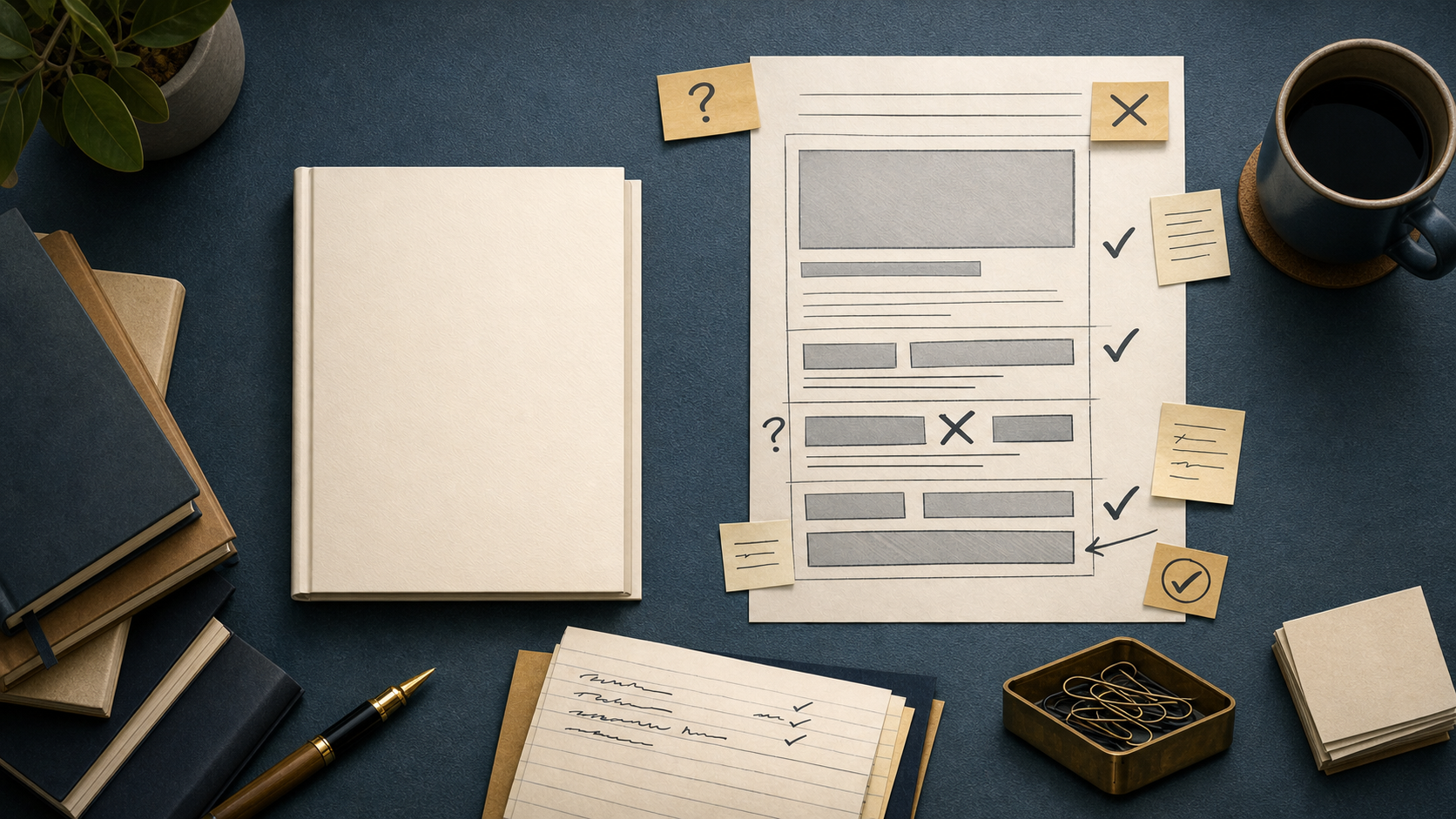
A cover and sales page are trust signals before they are sales tools.
The cover, title, subtitle, description, author context and buying page all create an early impression. That impression may be generous, sceptical or confused.
For independent non-fiction authors, the cover and sales page are trust signals before they are sales tools.
The common misunderstanding
The common mistake is to treat the cover as decoration and the sales page as a place to summarise the book.
A cover is not just an image. It tells the reader what kind of book this is, what shelf it belongs on, and whether it looks professionally handled.
A sales page is not just a description. It is a decision environment.
The system underneath
Readers rarely evaluate one element in isolation. They compare signals.
A serious subtitle with a generic cover creates tension. A polished cover with a vague description creates doubt. A strong premise with no author context may leave the reader unconvinced. A book that claims to be evidence-led but offers no sense of method can feel thin.
The reader is asking whether the promise, presentation and proof belong together.
What this means in practice
Look at the cover first from a distance. Can the category be understood? Does the tone fit the subject? Does it look like a deliberate publishing decision rather than a placeholder?
Then look at the sales page. The opening should clarify the reader problem or question. The body should explain the book’s promise without overclaiming. The author bio should support trust. The sample should confirm the quality suggested by the page.
The goal is coherence.
What to avoid
Avoid covers that chase trends without serving the book.
Avoid descriptions that summarise chapter contents but never explain why the reader should care.
Avoid claims that sound impressive but cannot be substantiated.
Avoid treating the sales page as a place to compensate for weak positioning. If the book is hard to explain, fix the positioning first.
Practical checklist
Review the page as if you were a sceptical reader:
- Can I tell what kind of book this is?
- Does the cover match the subject and reader expectation?
- Does the description make a clear promise?
- Is the author’s credibility visible?
- Is there enough proof without overloading the page?
- Does the sample support the sales copy?
- Does anything feel exaggerated, generic or mismatched?
Closing thought
A good cover and sales page do not pressure the reader into buying. They help the right reader feel confident enough to continue.
That is why critique should focus less on taste and more on trust.
See Book Cover and Sales Page Critiques for related guidance.