
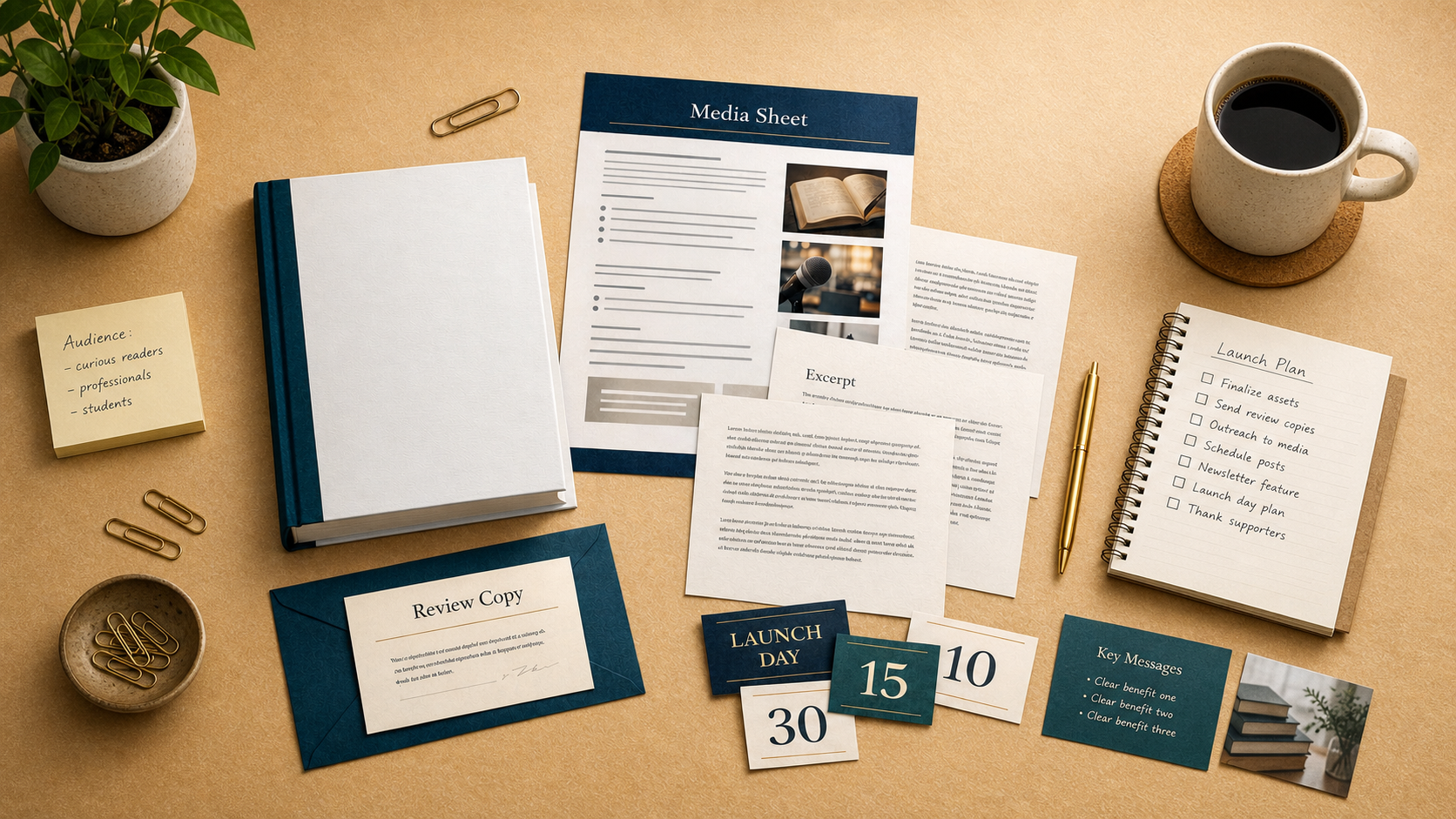
Launch assets sound like marketing extras. They are more practical than that.
The right assets help readers, reviewers, collaborators and media contacts understand a book quickly. They reduce friction at the moment attention arrives.
For serious non-fiction authors, launch assets are trust tools.
The common misunderstanding
The common mistake is to prepare assets only after someone asks.
By then, the author is already working under pressure. The description may be inconsistent, the bio too long, the cover file hard to find, the review-copy process unclear and the key points scattered across documents.
A launch should not depend on improvisation.
The system underneath
Different people need different information.
A reviewer needs a review copy, description, publication date, author context and disclosure clarity. A podcast host may need a short bio and topic angles. A reader needs the book promise. A bookseller or librarian may need metadata, ISBN and format information.
Launch assets organise that information before the request arrives.
What this means in practice
Prepare a concise book page first. It should include cover, description, buying links, format information and author context.
Then prepare supporting assets: short and medium author bios, high-quality cover image, press-style book description, review-copy note, topic angles, sample Q&A if relevant, and a clear contact route.
These do not have to be elaborate. They have to be accurate and easy to use.
What to avoid
Avoid over-designed media kits that hide the basic facts.
Avoid making reviewers search for contact details or formats.
Avoid changing the book description every time you send it.
Avoid treating launch assets as hype documents. Their job is clarity.
Practical checklist
Before launch, prepare:
- Book cover image.
- Short description.
- Longer description.
- Author bio in two lengths.
- ISBN, formats and publication date.
- Review-copy availability.
- Key topic angles.
- Website and buying links.
- Contact details.
- A clear note on what kind of coverage or review is appropriate.
How to use these assets
Think of launch assets as a shared source of truth. The same short description should appear on the book page, in review-copy notes and in outreach unless there is a good reason to adapt it. The same author bio should not become more inflated each time it is pasted into a new context.
This consistency matters because readers and reviewers may encounter the book in more than one place. If every version sounds different, the book starts to feel less stable. If the assets reinforce the same positioning, the launch feels more deliberate.
It is also worth preparing private notes for yourself: who has been contacted, when review copies were sent, which links are live and which claims should not be made. A calm launch is often the result of boring preparation done early.
Closing thought
Launch assets do not create interest by themselves. They make existing interest easier to act on.
That is unglamorous work, but it is often the work that makes a launch feel professional.
See more in Non-Fiction Book Launches.