
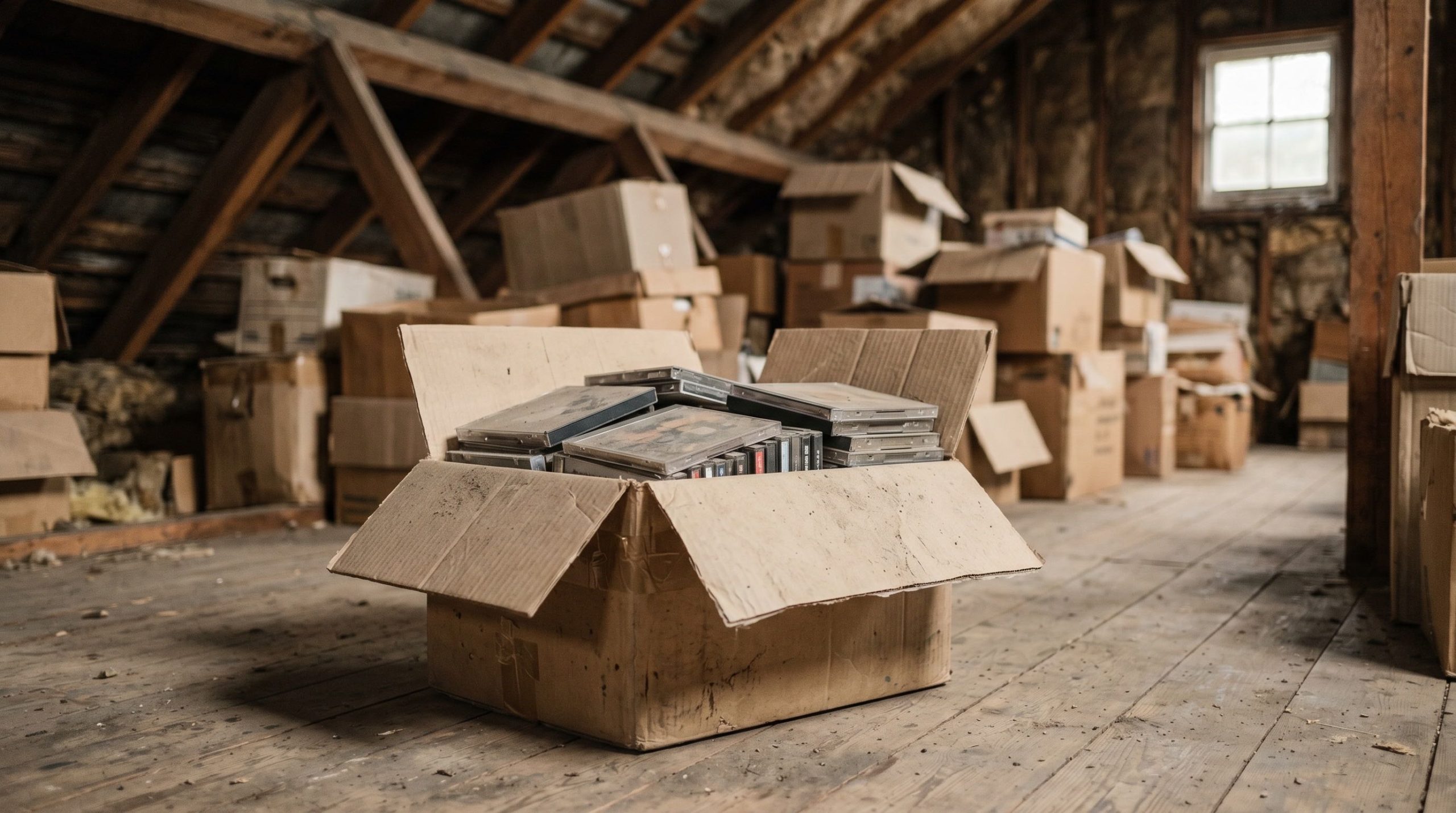
Old DVDs are easy to ignore until you try to throw them away.
It is probably in the loft, or under the stairs, or in that cupboard in the spare room that you have been meaning to sort out for three years. It contains DVDs you have not watched since 2011. CDs that predate any device in your house capable of playing them. Possibly a VHS tape or two, kept for reasons you would struggle to articulate.
You have not thrown them away. You have also not done anything with them. They sit there, neither useful nor gone, occupying physical space and a small amount of mental space, the latter being the more interesting problem.
The Weight of Real Ownership
Physical objects that you own behave differently to digital access that you subscribe to, in ways that only become apparent when the object stops being useful.
A DVD you bought in 2003 is still yours. The transaction is complete. The object exists. It has weight and corners and a case with a crack where someone dropped it. You cannot return it, cannot exchange it, and cannot easily transfer its value to anything else. This is ownership in its most literal form: a thing you have, fully and permanently, with all the inconvenience that implies.
Digital content does not have this problem, because it does not have this quality. When a streaming service removes a film from its catalogue, you are not left holding anything. There is nothing to put in a box. There is nothing to not throw away. The loss is clean, which is one of its advantages, and also one of the things that makes it feel slightly unreal.
Why the Box Persists
There are several reasons people hold onto physical media they cannot use, and most of them are more rational than they appear.
The first is sunk cost. You paid for those DVDs. Throwing them away does not recover the money, but it does make the loss feel final in a way that storing them does not. The box in the loft allows you to maintain the fiction that the investment still exists.
The second is residual value, which is usually smaller than people hope. Second-hand DVDs sell for very little now — resale platforms like CeX typically offer a matter of pence for standard titles. But very little is not nothing, and the prospect of converting the box to cash, however modest, keeps it from the bin.
The third, and this is the one worth examining, is that the objects represent something beyond their function. A DVD of a film you loved is a record of having watched it, of having chosen it, of having owned it at a particular moment in your life. Streaming history is not the same. Nobody keeps a box of URLs.
What Your Old DVDs Are Actually Telling You
The persistence of the box is, in its own way, a data point about ownership.
We do not accumulate digital subscriptions the same way. When you cancel a streaming service, you do not keep a record of everything you watched. There is no physical residue. The relationship ends cleanly, leaving nothing behind, which is convenient, and also slightly disconcerting, if you think about it long enough.
The things in the box were yours in a way that your streaming library is not. They carry the specific gravity of real ownership: the inconvenience, the permanence, the stubborn refusal to simply disappear when they are no longer needed.
They are difficult to throw away because you genuinely own them. That difficulty is not a problem to be solved. It is the point.
Read alongside How We Stopped Owning Things Without Noticing, Why Some People Are Buying Physical Media Again, and Nothing to Show for It for the broader argument about what ownership leaves behind.
Nothing to Show for It by Ian Wilkinson expands this argument into a full account of how ownership gave way to access, and what was quietly lost in the exchange. Paperback £9.99. Kindle £2.99. Free on Kindle Unlimited. Read more about the book, see edition details, and buy your copy here.