
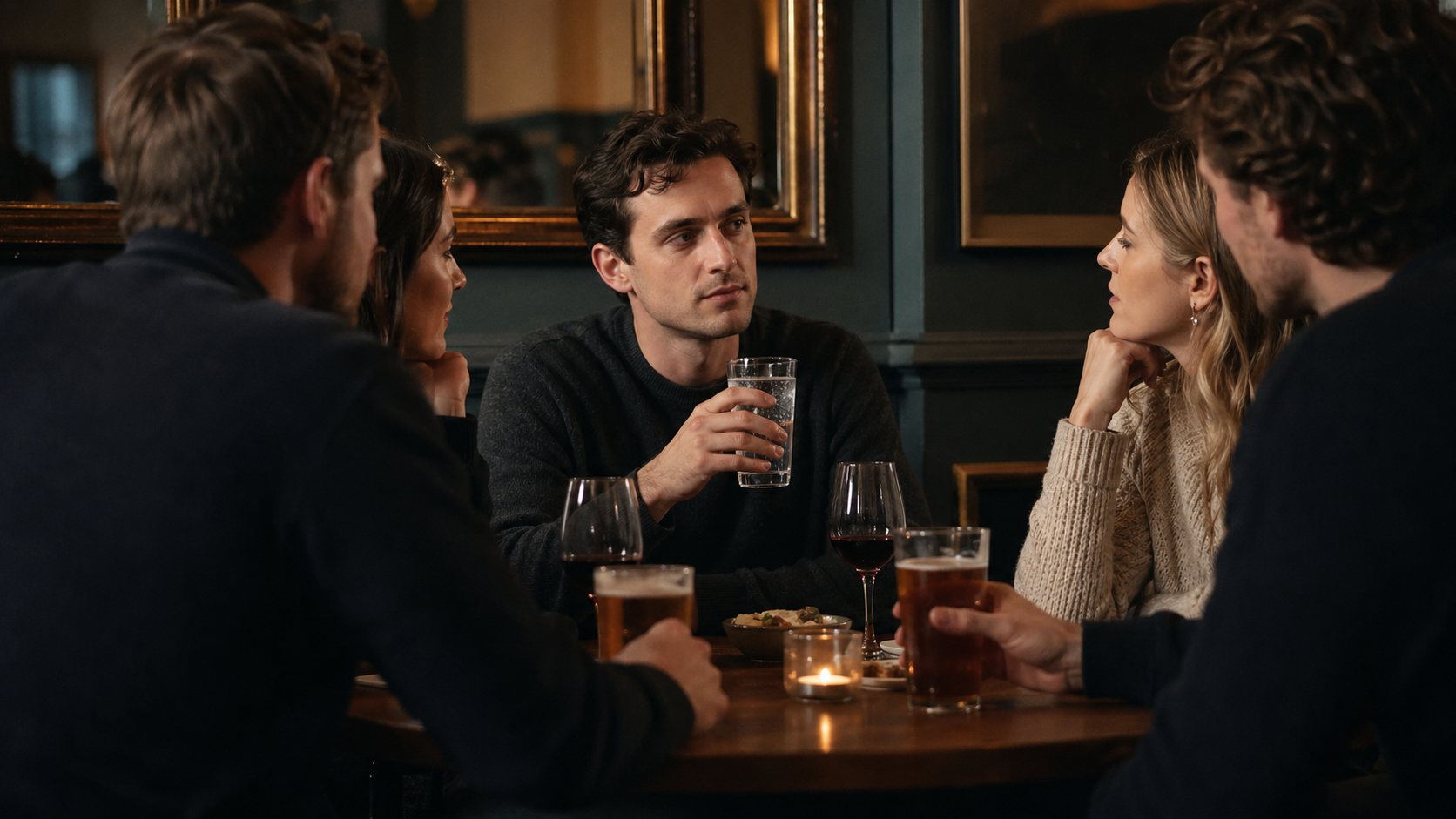
There is a social script for drinking, and most people follow it without noticing it exists. Social pressure drinking is built into this interaction before anyone has spoken. Someone offers you a drink. You accept. No explanation required. The evening proceeds.
Now imagine declining. What happens next, in most social settings, is that you are asked why. Are you driving? Are you on antibiotics? Are you pregnant? The questions come quickly and without much self-consciousness, because the person asking does not feel they are doing anything unusual. They are simply trying to understand a deviation from the expected pattern.
This is what social pressure drinking looks like in practice, and it operates almost entirely below the surface.
Why social pressure drinking makes refusing the exception
In British social culture, drinking is the default. Not drinking is the exception that requires accounting for. This asymmetry is so familiar that it barely registers, but it is genuinely strange when you examine it. No one is asked to explain why they are eating a bread roll or drinking a glass of water. The drink is different.
The default position means that the cost of not drinking is always higher than the cost of drinking. Accepting a drink is frictionless. Declining one requires either a ready explanation, the willingness to field questions, or the social confidence to say nothing and tolerate a brief awkwardness.
Most people, faced with that calculation, take the drink. Even when they would rather not. Even when they are not particularly enjoying it.
Where the script comes from
The social role of alcohol in Britain has deep historical roots. But social pressure drinking as it exists today, the round-buying, the after-work drink, the glass of wine as the signal that a social occasion has properly begun, has been actively shaped and reinforced by an industry with a significant financial interest in drinking being the norm.
As the biggest lies about giving up alcohol tend to centre on what you will lose, the social script is part of that picture. The industry has spent decades associating its products with celebration, relaxation, connection and adulthood. The result is a cultural environment in which not drinking feels, to many people, like opting out of something.
The accommodation problem
One of the more revealing aspects of the social script is who gets to set the terms. Why non-drinkers have to justify themselves is a question that tends to produce a certain amount of indignation in people who drink. They are not doing anything wrong, they say. They are just being sociable.
That is true. The social pressure around alcohol is rarely malicious. It is generally well-meaning, even affectionate. The person offering the drink genuinely wants you to enjoy yourself. But the structure of the interaction means that the non-drinker is always the one who needs accommodating, and the accommodation always comes at a small social cost.
What changes when you notice it
Once you start to notice the script, it becomes very hard to stop noticing it. The way a round of drinks pulls everyone back into drinking even when they had been about to stop. The way a dinner party host refills glasses without asking. The way “just the one” becomes two or three because each drink resets the social expectation.
None of these are conspiracies. They are just the accumulated weight of a culture that has built drinking into its social architecture in ways that make it very hard to opt out gracefully. Noticing that architecture does not mean abandoning social life. The social pressure drinking creates is structural, not personal. The friction you feel when you decline a drink is not a personal failing. It is the script doing exactly what it was designed to do.
The alcohol-free option
One practical consequence of social pressure drinking is that the presence of decent non-alcoholic alternatives genuinely changes the dynamics. When there is something interesting to drink that is not alcohol, the negotiation becomes easier. The question is no longer “why aren’t you drinking?” but simply “what would you like?”
The growth of the non-alcoholic drinks market over the past decade is partly a response to this. People want to participate in the social ritual without the alcohol. They want something that signals “I am here and engaged” without requiring an explanation. The script has not gone away, but it is becoming, slowly, a little more flexible.
The Quiet Con by Ian Wilkinson expands this argument into a full account of how drinking was made to feel normal, harmless, and beyond serious question. Paperback £9.99. Kindle £2.99. Free on Kindle Unlimited. Read more about the book, see edition details, and buy your copy here.
Stay up to date with new writing from Ian Wilkinson at thequietcon.substack.com