
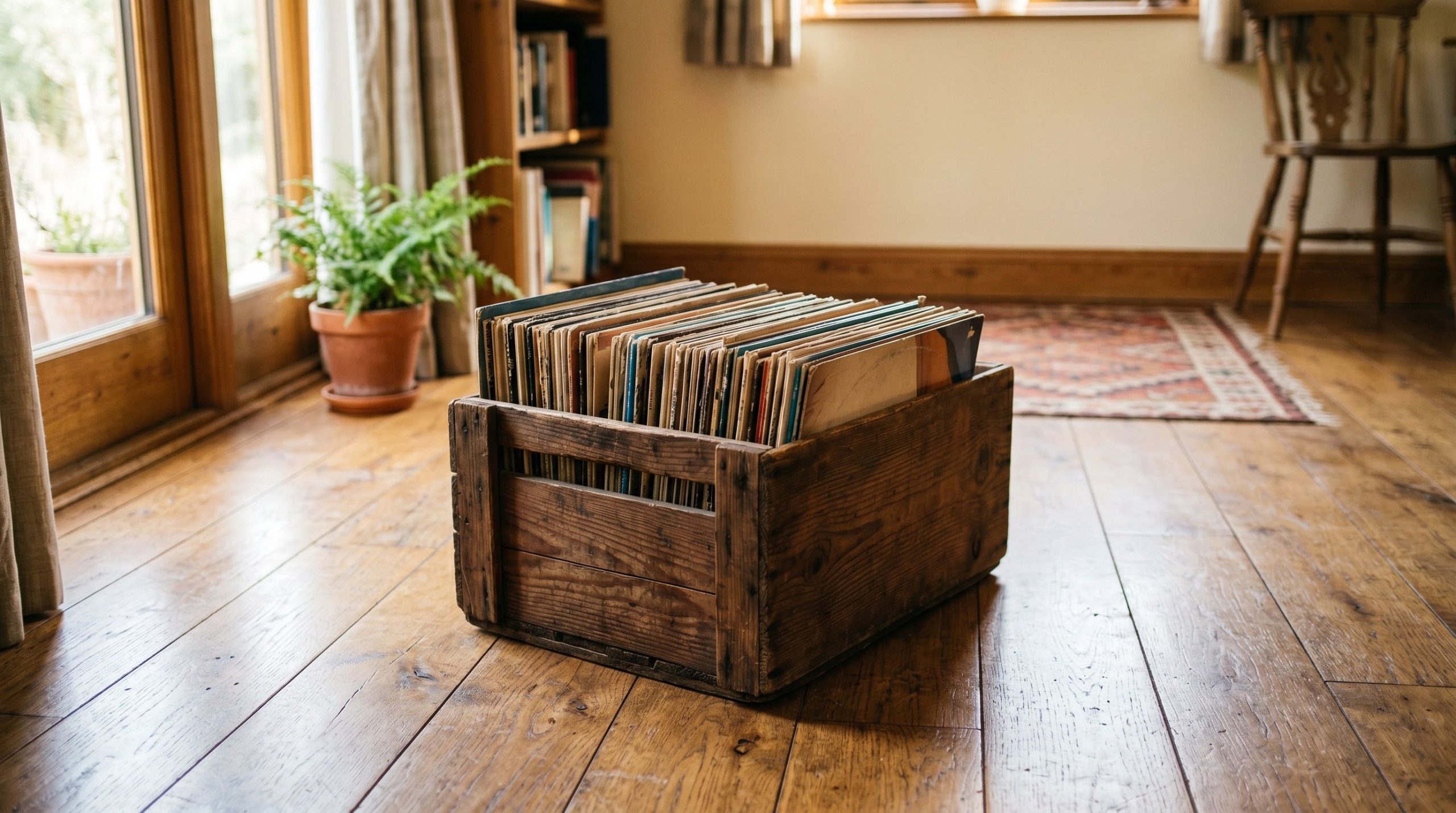
A record collection used to say something about the person who owned it.
You notice them noticing things. The books on the shelf. The records in the crate. The CDs stacked in the corner. You have not arranged these things for them, they have been there for years, but you are suddenly aware of what they communicate. Your taste. Your history. The version of yourself you have assembled over time, one purchase at a time, and left lying around the room as evidence.
That is no longer how music works. And the loss is more interesting than it might first appear.
What a Record Collection Said
A record collection was not storage. It was a portrait.
Not a curated one, in the way that social media profiles are curated. Nobody posed their LPs for effect. Nobody arranged their CDs in the order most likely to impress. They were simply there, accumulated over years, reflecting genuine decisions, showing the full embarrassing range of a person’s taste rather than the carefully edited highlights.
This is what made them interesting. A shelf that contained both Astral Weeks and the entire back catalogue of Supertramp was telling you something true about its owner. A playlist that contained both would be invisible, filed somewhere on a server, shared with nobody unless deliberately exported and labelled.
Physical collections were legible in a way that digital libraries are not. They could be read by anyone who walked into the room. They could be argued about, borrowed from, judged, misunderstood, and discovered. They were social objects. The shift to streaming — a transition the BPI has charted in its annual industry reports — removed this quality entirely.
What Ownership Actually Meant
When you bought a record, you committed to it in a way that streaming does not require. You had paid for it. It was in your house. If it turned out to be disappointing, that was your problem. If it turned out to be extraordinary, it sat there on the shelf as a permanent reminder of the moment you found it.
This is not nothing. The friction of physical ownership, the cost, the space, the weight, produced a different relationship with music than frictionless access does. You listened more carefully to things you had paid for. You gave albums more time, because you had already made the investment. You developed opinions that were yours, formed through repeated listening rather than the algorithmic nudge toward the next thing.
The recommendation engine is extraordinarily good at finding you music you will like. It is considerably less good at finding you music that will matter to you. Those are different processes, and the difference is partly explained by the fact that one of them involves your money and your shelf space and a decision you cannot easily reverse.
The Identity Question
There is a subtler loss here too, which is harder to articulate but worth trying.
A physical collection was an identity that existed independently of any platform. It could not be changed by a company’s licensing decision. It could not be altered by an algorithm. It could not be taken away if you stopped paying a monthly fee. It was yours in a way that felt permanent, and that permanence was part of what it meant.
Your streaming library is not yours in the same sense. It is access to a service. The music you have saved, the playlists you have built, the listening history that has shaped your recommendations, none of it transfers. If the service closes, or changes its terms, or loses the licensing rights to half your favourite albums, you have no recourse. You were never an owner. You were always a subscriber.
The record collection you built between 1983 and 1997 is still yours. The music you have been listening to for the last decade largely is not.
Read alongside Why Some People Are Buying Physical Media Again, Why You Cannot Throw Away Your Old DVDs, and Nothing to Show for It for the larger story of ownership, taste, and permanence.
Nothing to Show for It by Ian Wilkinson expands this argument into a full account of how ownership gave way to access, and what was quietly lost in the exchange. Paperback £9.99. Kindle £2.99. Free on Kindle Unlimited. Read more about the book, see edition details, and buy your copy here.